Blog
Wegovy Tablets vs Wegovy Injection: What’s the Difference?
Sep
Wegovy Tablets vs Wegovy Injection: What’s the Difference?
Wegovy has become one of the best-known prescription medicines for medical weight management. Until recently, most patients knew Wegovy as a once-weekly injection.
That has now changed.
A new once-daily Wegovy tablet containing the same active ingredient, semaglutide, has been approved for weight management in adults.
This gives eligible patients another way of taking semaglutide and may be particularly interesting for people who would prefer an oral weight-loss medicine rather than an injection.
But are Wegovy tablets the same as Wegovy injections? Do they work as well? And which formulation might be more suitable?
Here we explain the important differences.
What is Wegovy?
Wegovy is a prescription medicine containing semaglutide, which belongs to a group of medicines known as GLP-1 receptor agonists.
GLP-1 — glucagon-like peptide-1 — is a naturally occurring hormone involved in appetite and blood-glucose regulation.
Semaglutide mimics the effects of GLP-1 and acts on areas of the brain involved in appetite regulation. This can:
- reduce hunger
- increase feelings of fullness
- reduce food cravings
- help people consume fewer calories
- support long-term weight management when combined with appropriate dietary and lifestyle measures
Wegovy has traditionally been administered as an injection under the skin once a week.
Wegovy is now also available in a tablet formulation for adults, providing an oral alternative to injectable treatment.
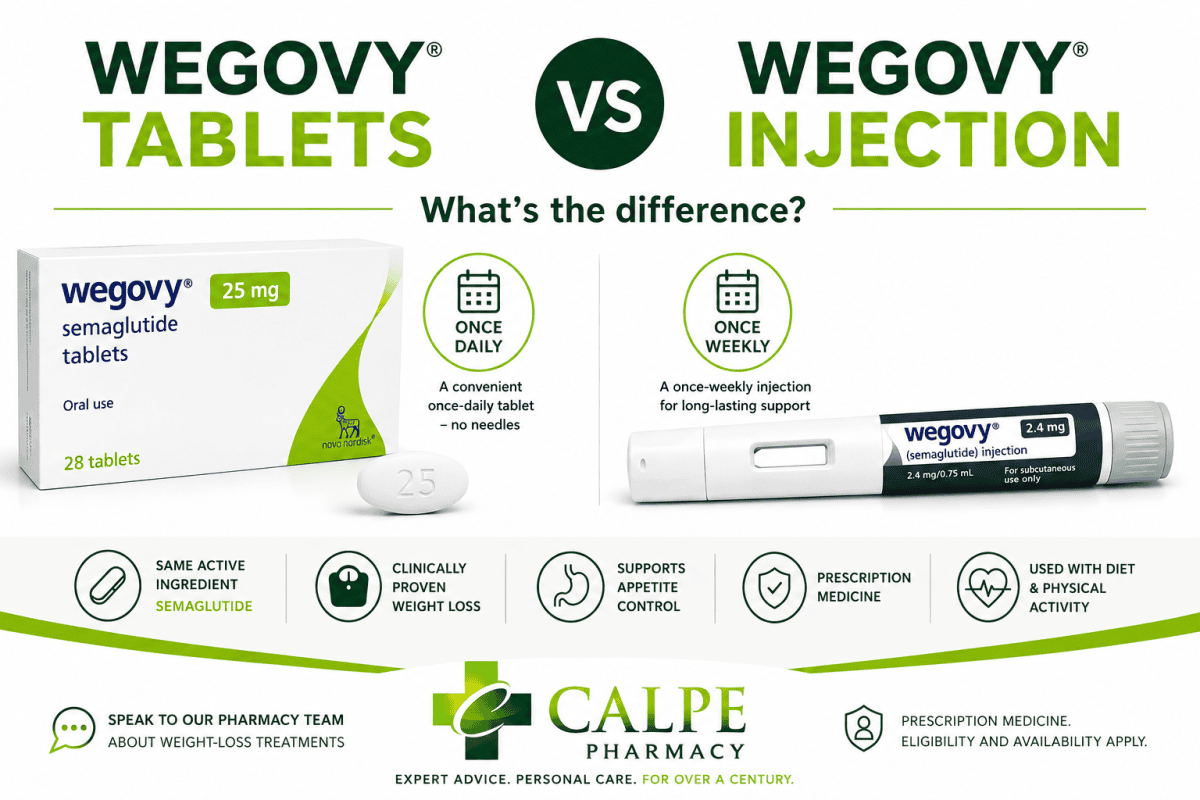
Importantly, both formulations contain semaglutide. The principal difference is how the medicine gets into the body and how often it is taken.
What are Wegovy tablets?
Wegovy tablets are an oral formulation of semaglutide developed specifically for weight management.
The tablets are taken once daily.
The UK Medicines and Healthcare products Regulatory Agency (MHRA) approved Wegovy tablets for weight loss and weight management in June 2026.
The available tablet strengths are:
- 1.5 mg
- 4 mg
- 9 mg
- 25 mg
Treatment starts at 1.5 mg once daily and the dose is gradually increased, normally with at least one month at each dose level, towards the 25 mg maintenance dose where appropriate.
This gradual dose escalation is intended to improve tolerability, particularly gastrointestinal side effects.
How do you take Wegovy tablets?
There is an important difference between Wegovy tablets and many ordinary tablets.
Wegovy tablets need to be taken under specific conditions to allow semaglutide to be absorbed properly.
According to current product information, the tablet should generally be:
- taken once daily
- taken on an empty stomach after at least 8 hours of fasting
- swallowed whole
- taken with a small amount of water — up to approximately 120 mL
- followed by a wait of at least 30 minutes before eating, drinking or taking other oral medicines
This routine is important because food and larger quantities of water can reduce the absorption of oral semaglutide.
Patients should always follow the instructions supplied with their medicine and the advice of their prescriber or pharmacist.
How is Wegovy injection taken?
Wegovy injection is administered once weekly as a subcutaneous injection — an injection underneath the skin.
Common injection sites include the:
- abdomen
- thigh
- upper arm
Patients are normally started on a low dose and the dose is gradually increased.
For many patients, one of the main advantages of injectable Wegovy is convenience: instead of remembering medication every morning, treatment is generally required only once a week.
For others, however, the prospect of using a needle can be a significant disadvantage.
This is where the new tablet formulation could offer an important alternative.
Wegovy Tablets vs Wegovy Injection: Quick Comparison
| Feature | Wegovy Tablets | Wegovy Injection |
|---|---|---|
| Active ingredient | Semaglutide | Semaglutide |
| Medicine class | GLP-1 receptor agonist | GLP-1 receptor agonist |
| Route | Oral tablet | Subcutaneous injection |
| Frequency | Once daily | Once weekly |
| Needles required | No | Yes |
| Starting dose | 1.5 mg daily | 0.25 mg weekly |
| Standard adult maintenance dose | 25 mg daily | Commonly 2.4 mg weekly* |
| Dose escalation | Yes | Yes |
| Special administration requirements | Yes | No fasting requirement |
| Taken on an empty stomach | Yes | No |
| Wait before food/drink/other tablets | At least 30 minutes | Not applicable |
| Used alongside diet & physical activity | Yes | Yes |
| Common side effects | Mainly gastrointestinal | Mainly gastrointestinal |
| Prescription medicine | Yes | Yes |
| Main practical advantage | Needle-free | Once-weekly administration |
*The appropriate injectable dose depends on the individual patient and current authorised product information. Higher injectable dosing has also been authorised for certain adults with obesity in the UK.
Do Wegovy tablets and injections contain the same medicine?
Yes.
Both contain semaglutide.
However, a 25 mg tablet should not be considered equivalent to injecting 25 mg of semaglutide.
Only a small proportion of orally administered semaglutide reaches the circulation. The tablet therefore uses a higher numerical dose and contains an absorption-enhancing ingredient to help semaglutide cross the stomach lining.
The current UK product information states that average semaglutide exposure from the 25 mg oral maintenance dose is comparable to that achieved with the 2.4 mg injectable dose, although absorption of oral semaglutide is more variable.
This is an important reason patients should never attempt to calculate their own equivalent dose or switch between formulations without professional advice.
Which is more effective for weight loss?
Both formulations have demonstrated substantial weight loss in clinical trials.
In the OASIS 4 trial, adults without diabetes who received oral semaglutide 25 mg alongside lifestyle intervention experienced an estimated average body-weight reduction of approximately 13.6% after 64 weeks, compared with 2.2% with placebo.
In the landmark STEP 1 trial, adults without diabetes receiving once-weekly injectable semaglutide 2.4 mg alongside lifestyle intervention experienced an average body-weight reduction of approximately 14.9% after 68 weeks, compared with 2.4% with placebo.
These figures may look remarkably similar, but they should not be interpreted as a direct head-to-head comparison.
The studies were conducted separately, involved different groups of participants and used different study designs and treatment periods.
The important message is that both oral and injectable semaglutide have demonstrated clinically meaningful weight reduction.
Individual results can vary considerably.
Is the Wegovy tablet simply “Wegovy without the needle”?
In one sense, yes: both formulations deliver semaglutide for weight management.
In practice, however, there are meaningful differences.
Advantages of Wegovy tablets
For suitable patients, possible advantages include:
- no injections
- no needles
- potentially preferable for patients with needle anxiety
- familiar tablet format
- another treatment option for patients considering GLP-1 therapy
Potential disadvantages of Wegovy tablets
The tablet requires a relatively strict daily routine.
Patients need to take it after fasting and then wait before eating, drinking or taking other oral medication.
Because it is taken every day, remembering the dose consistently is also important.
Advantages of Wegovy injection
The major convenience is frequency.
Wegovy injection is generally administered once weekly, rather than every day.
It can also be taken independently of meals.
Potential disadvantages of Wegovy injection
Some patients simply dislike needles or self-injection.
Others may prefer the familiarity of taking a tablet.
Neither route is automatically “better”. The best option depends on the individual patient.
What are the side effects of Wegovy?
Because both medicines contain semaglutide, their side-effect profiles have many similarities.
The most common side effects are gastrointestinal and can include:
- nausea
- diarrhoea
- vomiting
- constipation
- abdominal discomfort or pain
These effects can be more noticeable when starting treatment or when increasing the dose.
This is one reason both formulations use gradual dose escalation.
Less common but potentially important adverse effects and precautions also exist. Patients should read the Patient Information Leaflet supplied with their medicine and seek professional advice if they develop concerning or persistent symptoms.
Sudden loss or rapid worsening of vision requires urgent medical assessment. Product information for semaglutide has been updated regarding the very rare risk of non-arteritic anterior ischaemic optic neuropathy (NAION).
Who may be eligible for Wegovy tablets?
Current UK and European indications include adults with:
A BMI of 30 kg/m² or above
or
A BMI from 27 kg/m² to below 30 kg/m² together with at least one weight-related health condition.
Examples of weight-related conditions can include:
- prediabetes or type 2 diabetes
- high blood pressure
- abnormal cholesterol or blood lipid levels
- obstructive sleep apnoea
- cardiovascular disease
Wegovy is intended to be used alongside a reduced-calorie diet and increased physical activity.
The tablets are currently intended for adults, whereas injectable Wegovy also has authorised use in certain adolescents.
Eligibility does not necessarily mean that Wegovy is suitable for a particular person. A healthcare professional needs to consider medical history, current medication, contraindications and other individual factors.
Can you switch from Wegovy injection to Wegovy tablets?
Potentially, but switching should be undertaken with professional guidance.
Current UK prescribing information allows patients receiving semaglutide 2.4 mg injection once weekly to transition to semaglutide 25 mg tablets once daily, with tablets starting one week after the final injection.
However, the product information specifically notes that the effect of switching cannot be predicted precisely because absorption of oral semaglutide is more variable than absorption following injection.
Do not switch formulations or attempt to calculate an equivalent dose yourself.
Speak to your prescriber or pharmacist first.
Can Wegovy be taken with Ozempic or another GLP-1 medicine?
Wegovy should not be combined with another semaglutide-containing medicine or another GLP-1 receptor agonist unless specifically directed within authorised prescribing guidance.
For example, patients should not independently combine Wegovy with medicines such as Ozempic or another GLP-1 treatment in an attempt to increase weight loss.
Using more medication does not necessarily produce better results and can increase the risk of adverse effects.
Wegovy Tablets vs Injection: Which should I choose?
For an appropriate patient, the decision may ultimately come down to a combination of clinical suitability and personal preference.
Wegovy tablets may appeal to you if:
- you strongly prefer tablets
- you dislike injections or needles
- you are comfortable following a daily fasting routine
- taking a daily medicine fits easily into your lifestyle
Wegovy injection may appeal to you if:
- you prefer once-weekly rather than daily treatment
- you do not mind self-injection
- you want to avoid the tablet’s fasting and timing requirements
- you already use injectable Wegovy successfully
The decision should not be based on convenience alone.
Your medical history, other medicines, previous GLP-1 treatment, side effects, treatment goals and the locally available formulations should all be considered.
Wegovy and Weight-Loss Treatment in Gibraltar
The arrival of oral Wegovy represents an important development in medical weight management.
Patients considering Wegovy in Gibraltar now have another potential treatment option to discuss with a healthcare professional as availability and prescribing arrangements evolve.
At Calpe Pharmacy, our pharmacists can provide information about prescription weight-management medicines, including Wegovy and other GLP-1 treatments, and help patients understand how these medicines are used safely and appropriately.
Availability of individual medicines and formulations can change, and all prescription-only medicines remain subject to an appropriate prescription and professional assessment.
Frequently Asked Questions
Is Wegovy available as a tablet?
Yes. Wegovy is now available as an oral semaglutide formulation for adults. The MHRA approved Wegovy tablets for weight management in the UK in June 2026, and Wegovy’s European product information also now includes an oral formulation.
Are Wegovy tablets the same as Rybelsus?
No. Although both contain semaglutide, they are different branded medicines with different authorised indications, strengths and dosing arrangements. Patients should not treat them as interchangeable.
How often do you take Wegovy tablets?
Wegovy tablets are taken once daily.
How often do you inject Wegovy?
Injectable Wegovy is normally administered once weekly.
Do Wegovy tablets work as well as the injection?
Both formulations have demonstrated substantial weight reduction in clinical trials. Oral semaglutide 25 mg produced an estimated average 13.6% reduction in body weight at 64 weeks in OASIS 4, while injectable semaglutide 2.4 mg produced an average 14.9% reduction at 68 weeks in STEP 1. However, these were separate clinical trials, so the percentages should not be used as a direct comparison.
Do you have to take Wegovy tablets on an empty stomach?
Yes. Current product information recommends taking oral Wegovy after at least 8 hours of fasting and then waiting at least 30 minutes before eating, drinking or taking other oral medicines.
What strengths do Wegovy tablets come in?
The current oral Wegovy strengths are 1.5 mg, 4 mg, 9 mg and 25 mg.
What is the normal Wegovy tablet dose?
Treatment starts at 1.5 mg once daily and is gradually increased through 4 mg and 9 mg towards a maintenance dose of 25 mg once daily where appropriate. Patients should follow their prescribed dosing schedule rather than increasing doses themselves.
Can I change from Wegovy injections to tablets?
Switching may be possible for some patients, but it should be discussed with a healthcare professional. Do not switch between Wegovy formulations without appropriate advice.
Which is better: Wegovy tablets or injections?
Neither formulation is automatically better. Tablets avoid needles, while injections offer the convenience of once-weekly rather than once-daily administration. Clinical suitability and individual preference should determine the choice.
Can I get advice about Wegovy in Gibraltar?
Yes. Speak to the Calpe Pharmacy team in Gibraltar for professional pharmacist advice about Wegovy, GLP-1 medicines and prescription weight-management treatment.
Speak to Calpe Pharmacy About Weight-Loss Treatment in Gibraltar
Considering Wegovy or another medical weight-management treatment?
Our pharmacy team can help you understand the different options available, how GLP-1 medicines work and the practical differences between oral and injectable treatments.
Speak to Calpe Pharmacy in Gibraltar for professional, personalised advice.
→ Explore our Medical Weight Loss Treatments in Gibraltar
→ Learn more about Wegovy
→ Compare Mounjaro, Wegovy and Ozempic
→ Contact the Calpe Pharmacy team
Prescription medicines are supplied only where legally and clinically appropriate and are subject to prescription requirements and availability.
Medical Disclaimer
Medical information notice: This article is provided for general educational purposes and does not replace individual medical advice, diagnosis or treatment. Prescription weight-management medicines are not suitable for everyone. Eligibility and treatment choice depend on factors including medical history, current medicines and individual clinical circumstances. Always consult an appropriately qualified healthcare professional before starting, stopping or changing prescription medication. Product indications, availability and regulatory status may change; always refer to the current Summary of Product Characteristics and Patient Information Leaflet.